
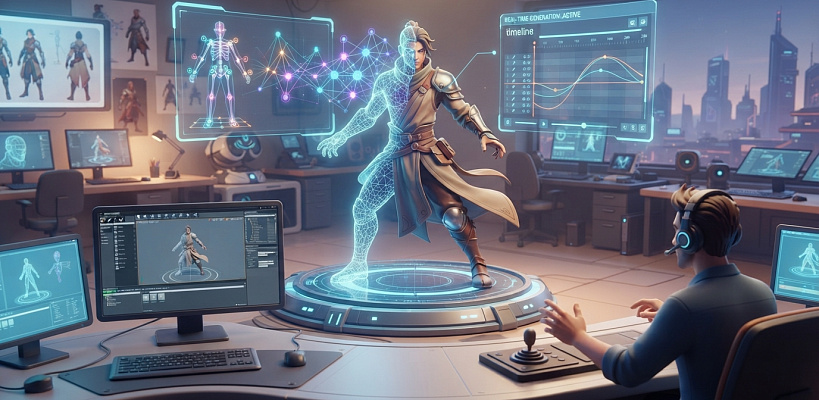

Market State 2026–2027: Why Manual Rigging Has Become a Luxury
By the end of 2026, the industry has finally redefined the role of technical art. Manual skinning and building bone hierarchies from a base "skeleton" have moved into the category of premium services, available only for AAA title protagonists or specific mechanical systems. For indie studios, outsourcing teams, and mobile developers, the classic pipeline no longer exists as a mass practice. The reason lies in the radical gap between the speed of game designers' prototyping and the throughput capacity of animation departments.
Modern store requirements for content update frequency—especially in the LiveOps segment on Unity (version 6.x) and Unreal Engine 5.5/5.6—dictate the need to release new skins, emotes, and interactions weekly. In conditions of senior rigger scarcity, whose salaries continue to grow at an outpacing rate, manual work on every asset becomes economically toxic. A studio simply cannot afford to spend two or three working days of a high-level specialist preparing a secondary NPC or a variational customization item.
The key driver of change has been integrated AI modules within the engines themselves. MetaHuman Animator 2.0 is no longer a tool exclusively for photorealism; its core is now widely used for transfer retargets even on stylized models thanks to improved geometry matching algorithms. In Godot 4.5, native support for neural network plugins allowed generating skin weight maps directly in the editor via text descriptions of deformation zones ("soft elbow bend," "hard armor fixation"). This reduced the preparation stage from hours of padding selection and mirroring to just a few minutes.
The economic model has shifted from paying for man-hours to paying for the quality of the final shape. The 2026 pipeline looks like this: the concept artist provides ZBrush blockout or High-poly scan, an ML model generates a draft rig and primary motion synthesis animation, while the technical artist acts merely as a corrector of joint interpolation errors. Tools like Autodesk Character Generator AI and open-source solutions based on transformers have learned to understand cloth physics during the bone structure creation phase, automatically placing collision capsules where humans usually make mistakes with tight-fitting clothes.
For mobile development, optimization for Snapdragon Elite 2026 series chips and Apple A19 Bionic became a critical factor. Neural networks for animation generation are now trained to consider real-time constraints: they output rotation curves without extra keys and immediately suggest the optimal LOD level for the influence mesh. If procedural rigging was once considered a compromise of quality for speed, today refusing it means losing the patch release race. Players expect seasonal content simultaneously across all regions, and a team tied to manual vertex weighting physically cannot close sprints.
In the context of graphics outsourcing, this led to input data standardization. Clients stopped requiring entire .rig files. Instead, a dataset of clean T-Pose/A-Pose poses and behavior description via Motion Canvas is transferred. The contractor uses cloud instances with last-gen GPUs to calculate deformations, returning ready-made FBX files with applied Blend Shapes for facial synchronization already included. Manual vertex editing remains the domain of micro-pauses in cutscenes, while the rest of the movement volume is created algorithmically.
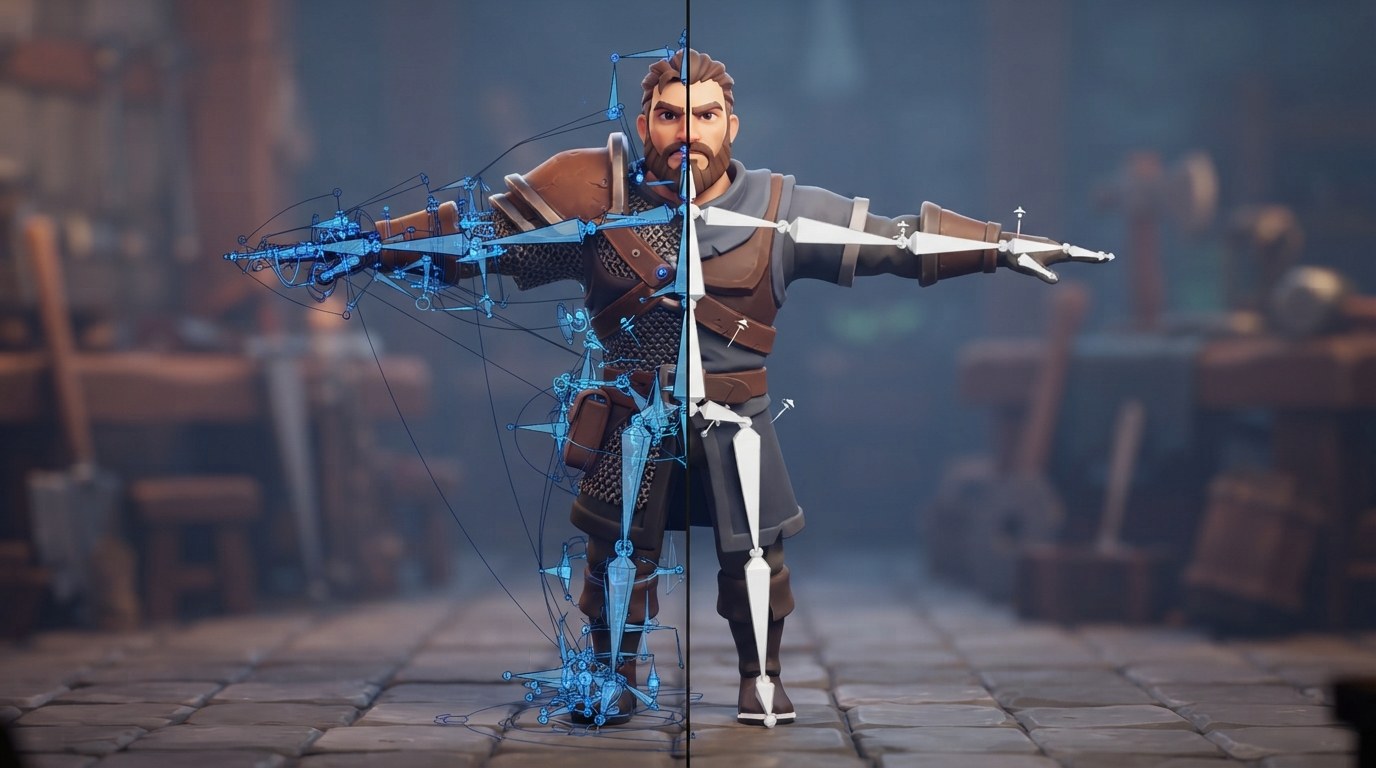
Tool Evolution: What Has Changed in Auto-Rig Pro, AccuRig, and Mixamo Over Two Years
During 2025–2026, the rigging pipeline ceased to be a manual craft. The main shift occurred from "semi-automation" to predictive networks that don't just attach bones but predict the functional architecture of the skeleton for a specific silhouette. While tools used to struggle with symmetry and weights, they now argue about kinematic constraints and physical correctness even before FBX export.
Auto-Rig Pro (version 4.x for Blender) has finally shifted its focus to modularity via the native Graph API. The key innovation is the Neural Blueprint mode. Instead of manually placing control points for shoulder blades or clavicles, you only need to set markers for the pelvis and skull. The network analyzes mesh topology, recognizes anatomical zones by UV clusters, and builds a bone hierarchy considering the expected range of motion. In 2026, the integration of a Soft-Constraints Solver directly during skinning became crucial. This eliminates the "chocolate bridge" effect on elbows during extreme poses without manual Weight Painting adjustments. For indie teams, support for USDZ Schema v3 is critical: AR avatar export for VisionOS happens with one click while preserving a compressed BlendShapes pool.
AccuRig (Reallusion) version 2.1 evolved from a Character Creator utility into an independent retargeting service. The main pain point of previous years—the loss of chest volume in female models in T-pose—was solved by implementing Volumetric Preservation Maps. The algorithm scans the source mesh, creates an invisible density shell, and ensures that the distance between bones doesn't collapse the geometry. An important change in 2026 was abandoning dependence on cloud rendering for weight map generation. A local TensorRT engine allows getting a ready Rig in approximately 14 seconds on RTX-class hardware. A smart clothing detector appeared: the system automatically generates a second layer of physics collisions for long coats, preventing fabric from falling through hips while walking.
Mixamo, which had long been the benchmark for speed, underwent a transformation after integrating Adobe Sensei Gen-3. It is no longer a MoCap library but a generator of contextual animations. You upload a static T-Pose, and the network reconstructs missing joints (e.g., fingers) if they are absent in the model. But the main feature is Semantic Motion Tagging. When uploading a model, you write a prompt: "tired guard, heavy armor." The system adapts the step amplitude and character's center of mass to their dimensions. In the context of Unity URP/HDRP projects, this saves hours of Root Motion setup. However, a licensing nuance emerged: stock sites began marking AI-generated cycles with a separate flag in GLB metadata, requiring compatibility checks with platform holder policies before release.
Built-in DCC tools have also caught up. Maya HumanIK received the Biomech Predictor plugin, which blocks impossible joint angles based on body type. Unreal Engine Control Rig in version 5.6 learned to perform inverse deformation: by changing the shape of the final metaphor (controller), you physically deform skin vertices in real-time, bypassing the recalculation of the entire graph.
The conclusion of this evolution is simple: a modern tool evaluates not only where to attach a bone but how that bone should breathe inside the muscular volume of a specific high-poly model.

Anatomy of a Modern ML Rig: From Point Cloud to Clean Topology Weights
In 2026 pipelines, neural rigging has ceased to be the magic of a "one-click" button and has transformed into a strict conveyor for converting raw data into an optimized deformation model. The source is most often dense geometry from photogrammetry or Gaussian Splatting, converted through next-generation MV-HMR (Multi-View Human Mesh Recovery) algorithms. The main task at this stage is to turn a chaotic cloud of polygons with implicit proportions into a predictable mesh with correct scale before moving on to skinning.
The first critical link is retopology without volume loss. Modern tools like AutoQuad v4 or TopoGen-X use diffusion transformers to build a quad-dominant mesh over a high-poly scan. Unlike approaches from previous years, current models are trained to preserve hard edges of joints even during the UV unwrapping phase. This helps avoid the classic "gummy" effect where soft tissues flow into each other with minimal bone rotation. For indie studios, the key factor has become the ability to run this stage locally on accelerators of the RTX 5070+ level thanks to optimizing models for INT8 precision.
The next step is pose extraction. Instead of outdated manual T-pose assignment, Pose Canonicalization Networks architecture is used. The neural network analyzes the input geometry, finds anatomical landmarks (ACR points), and forcibly straightens the character into an A-pose (neutral for game engines). At this same stage, automatic topology correction occurs around the deltoid muscles and hip joints—areas of maximum skin stretching. Errors at this stage are fatal: an incorrect shoulder angle will lead to weight collapse during motion capture animation.
The final stage is calculating skinning weights. In 2026, the de facto standard became a hybrid method: Heat Diffusion + Neural Blending. Classic bone heat gives a basic distribution of bone influence but leaves artifacts at elbow bends. The generative layer of the network draws out the weights to mimic the behavior of subcutaneous fat and fascia. The most important requirement for Google Play and App Store today is FPS stability, so the final setup must fit within the GPU Skinning Costs limit:
- Mobile High-End (iPhone 17 Pro / Android Flagship): no more than 0.3–0.4 ms per character;
- PC/Console Indie: strict control over the number of influencing bones (usually up to 4 per vertex), pruning weak weights below the 0.01 threshold is automated by the CleanWeights AI script.
Special attention is paid to compatibility with DCC software. The exported FBX undergoes verification via the USDZ Validator 2026. If the network detects non-manifold geometry or flipped normals in deformation zones, the process returns to the retopology stage. For procedural characters, Layered Rigging is used: the base spine is generated once, while limbs (tentacles, tails, cybernetic implants) are added as independent graph nodes with their own pre-calculated blend shapes for volume compression.
The result of this pipeline is a clean rig ready to accept Motion Matching data or animation created via text prompt. The absence of duplicate vertices, perfect quads in the joints, and physically plausible weight distribution allow rendering complex facial expressions in real-time even on mid-range devices, which is critically important for the mobile games market of the current hardware cycle.
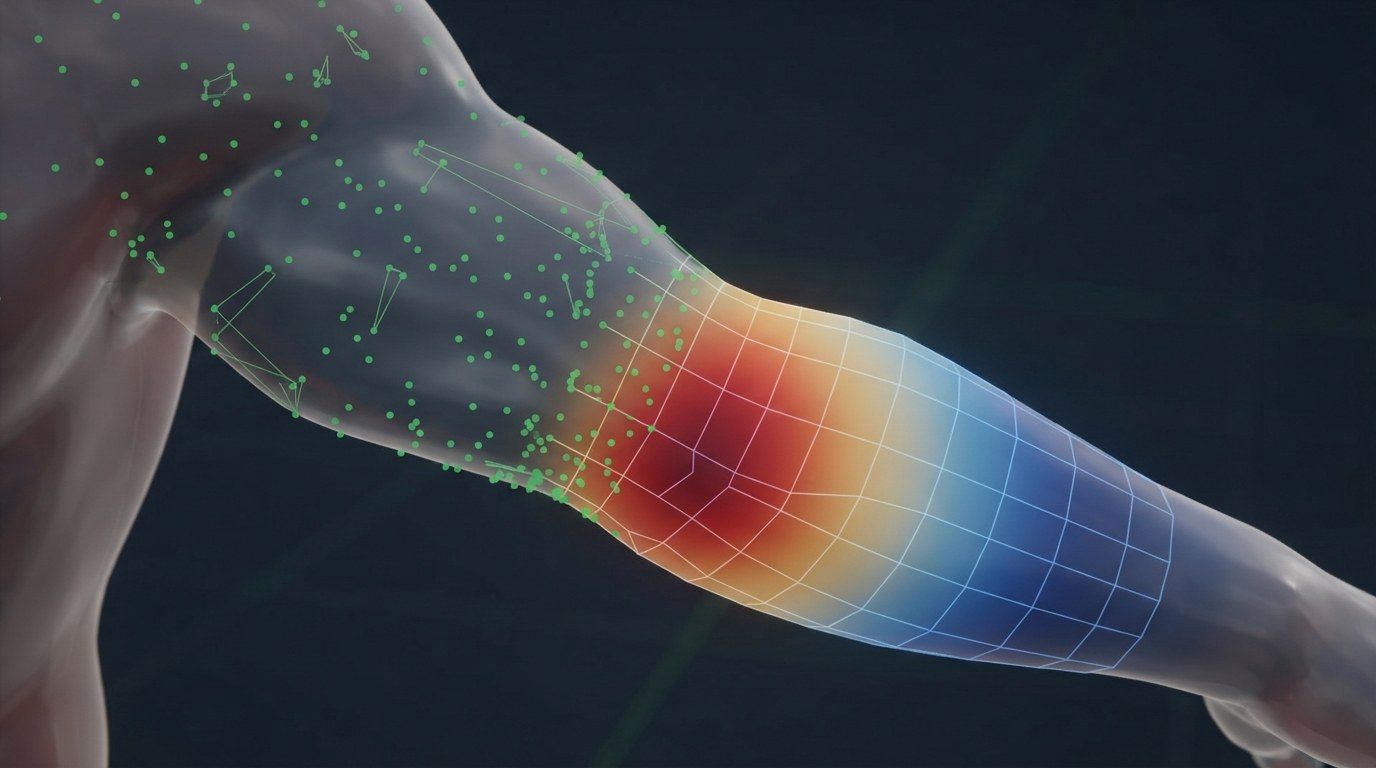
Next-Generation Facial Animation: Local Diffusion Models vs. Cloud APIs
By 2026, facial expressions have ceased to be an "expensive add-on" and have become a baseline requirement for holding attention in narrative games. Players are accustomed to the photorealism of Unreal Engine 5.4–5.5 and the emotional depth provided by audio-driven generation. Developers were forced to choose between two paradigms: running heavy models like Audio2Expression or Emotion ControlNet directly on the device (On-Device) for privacy and zero latency, or using streaming cloud APIs with pay-per-token and render-second pricing.
Local Approach: On-Device Diffusion and LCM Optimization
Running neural networks inside the game loop became possible thanks to the integration of Latent Consistency Models (LCM) and speculative decoding directly into engine runtimes. In Unity Sentis 2.3 and new NVIDIA ACE plugins, the local facial rig model operates as an asynchronous compute graph. The main pipeline looks like this: an audio buffer is captured from the microphone, cleaned by built-in DSP filters, and then fed into a transformer encoding head. It generates Blendshape weights not frame-by-frame, but in whole segments of animation curves.
The primary advantage is complete data control. For indie studios, this is critical due to Apple App Store Transparency and GDPR requirements: biometric face data never leaves the device. However, the price of this is aggressive memory management. To avoid freezes during dialogue sequences, teams use "Warm-up Pools": while loading a level, the GPU warms up tensor cores with empty model runs so that the first inference call takes a predictable 18–22 milliseconds. A typical mistake here is trying to run a full-face network every single frame. The correct practice for 2026 is launching it once every 3–4 frames followed by spline interpolation via Animation Rigging.
Cloud API: Streaming Morph Targets and Network Compromises
Cloud services like Replica Studios Live or specialized endpoints of Epic Online Services offer studio-grade quality without burdening the user's video card. The server-side model analyzes the voice actor's spectrogram and returns ready-made JSON with ARKit blendshape values or custom rig data via WebRTC DataChannels.
In 2026, the key factor in choosing the cloud became support for UDP streams with Forward Error Correction. This allows transmitting morph-target packets even when packet loss occurs over mobile internet. The main problem is latency (RTT). If RTT exceeds 80 ms, lips start lagging behind speech, which destroys immersion. The solution was the use of predictive buffers: the client side receives subtitle text half a second before the audio, builds a probabilistic map of phonemes, and opens the character's mouth in advance. As soon as the real weight packet arrives from the server, the system only corrects deviations.
Hybrid Shaping and Retargeting
The modern standard for AAA projects is hybrid. A lightweight local model processes first-order emotions (surprise, anger) instantly. The cloud connects as a background process to deliver fine-grained articulation nuances specific to the dubbing language. The final mesh is formed by blending these streams through Post Process Material Layering. At the same time, the final step always remains with the traditional Joint-based rig: the neural network outputs only shape targets, while tissue physics, hair collisions, and body mocap finish the image to a cohesive state Ready for Render.

Integration into Unreal Engine 5.5+: Live Link, Control Rig, and Post-ML Cleanup
In the ecosystem of Unreal Engine 5.5+, the pipeline for neural network rigging and animation generation has finally transitioned from an experimental tool category to a development standard. The key task at this stage is not just to import data from generative models (such as Motion Diffusion or Transformer-based IK solvers), but to seamlessly fit it into the production cycle with the ability to iterate without quality loss.
Stage 1: Data Transport via Live Link
Modern ML services for face tracking (FaceTrack AI) and inertial body capture now stream data directly via the Live Link protocol. Unlike old approaches involving FBX recording, using a Live Link Subject allows you to see the result in the UE editor in real-time. For custom characters, it is critically important to use a Live Link Preset with bone remapping. In 2026, most SDKs generate extended curves (Curves) along with joint rotations. These curves should be mapped immediately to your Animation Blueprint parameters, bypassing the baking stage into a clean action track sequence. This preserves the non-destructiveness of the source.
Stage 2: Normalization via Control Rig AI-generated animations often contain micro-jitter or "penetration" artifacts where limbs pass through geometry due to inaccurate estimation of mass-inertial characteristics. Instead of manual frame-by-frame correction, a two-level Control Rig is applied:
- Pre-processing Layer: Here, utility nodes are used to filter noise from the incoming Live Link signal. Quaternion smoothing functions with an adaptive window are used so as not to kill the sharpness of impacts.
- Fix-up Layer: At this level, Inverse Kinematics fixes work. If the ML model made a mistake with step length or jump height, procedural MetaHuman legs or a custom Leg Solver pull the feet to the collision surface (Floor Snap) during draft playback.
Stage 3: Retargeting and Correction Layers
When transferring from a generic metarig to a specific skeleton, the new Retarget Manager system with Per-Bone Properties Override support is used. However, the main tool here is Animation Layers. AI data is placed on the base layer (Base Pose). Corrective layers (Additive/Override layers) written manually by animators are laid on top of the machine base. In UE 5.5, the Stacked Blend Inertial Node modifier allows smoothly introducing manual edits only during moments of extreme acceleration, where algorithms most often make weight errors.
Stage 4: Post-ML Cleanup in Sequencer
Once the draft is approved, it is sent to the Level Sequence. Current practice implies refusing full mocap cleanup. The Curve Editor now has a built-in ML Denoiser that analyzes the frequency spectrum of the track and removes high-frequency noise above the threshold of human biomechanical perception, while preserving the low-frequency intentions of the actor. For facial animation, applying the Jaw Wiggle Correction node inside AnimBP is mandatory, as diffusion models tend to exaggeratedly open their mouths on vowel sounds.
Optimization for Real-time
The final stage before exporting to the game is Baking to Control Rig. You bake heavy procedural calculations and correction graphs into static keys but retain the Controls hierarchy. This gives game designers the ability to fine-tune the amplitude of emotions or weapon swing speed even after the heavy neuro-generation phase is complete, ensuring an ideal balance between production speed and handmade animation quality.
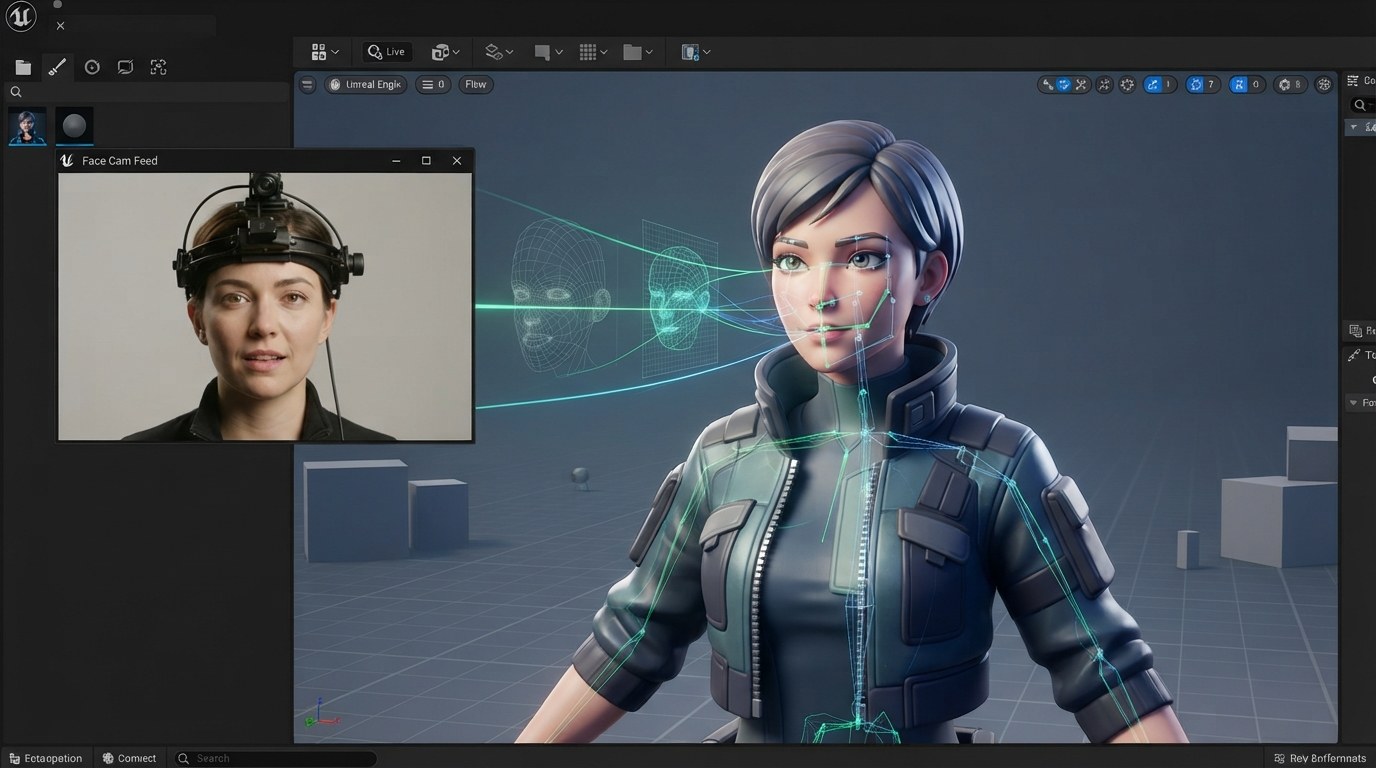
Unity 6 and Sentis: Moving Face Mocap Logic and Procedural Animation to Runtime
The transition of Unity to the Unity 6 architecture with a unified rendering stack (URP/HDRP) has finally established neural networks as a standard tool in the animation pipeline. The key player here is Sentis Runtime AI, which allows for running inference on optimized ONNX models directly inside the player without IPC overhead or data serialization between CPU/GPU. In the context of rigging, this means abandoning the "baking" of all movement variations in favor of dynamic pose synthesis.
The solution architecture revolves around two components: the Skeleton Graph API for manipulating bone hierarchies and a Compute-oriented deformation graph. Instead of performing heavy skinning across hundreds of bone influences every frame, the engine uses a lightweight Delta Model for offset correction. It takes current joint angles and IK solver outputs as input and returns a delta vector for the vertex buffer or quaternion corrections. This is critical for mobile platforms where the instruction budget for vertex shaders is strictly limited.
For facial animation, 2026 practices dictate a hybrid approach. Heavy emotion generation models work offline in the editor to create a library of base blendshapes. At runtime, however, a compact regression network weighing just 5–10 MB is launched via Sentis. Its task is to mix these shapes based on the specific camera angle and scene lighting. The model learns to compensate for mesh distortions during extreme head turns that were not covered by Mocap clips. Integration happens through custom Animation Jobs executed within the DOTS Job System backend, guaranteeing thread safety and preventing Main Thread Time spikes.
Modern app store requirements impose power consumption limits. Using the GPU variant of Sentis requires careful handling of resource barriers. The recommended pattern is asynchronous execution of GPGPU kernels for the neural network two frames before the character is actually displayed. Data is written to an intermediate RWStructuredBuffer, which is then seamlessly picked up by the final Character Rendering Pass. To prevent micro-stutters on devices with weak memory, Streaming Assets Bundles with LZ4-compressed models are used, whose decompression is delegated to the native memory manager of the runtime.
The specificity of the Unified Path in Unity 6 allows such computations to be embedded directly into SubTarget material graphs. Developers are increasingly refusing to pass ready-made morph targets from the CPU. Instead, the Vertex Stage of the shader accesses tensor weights loaded into Texture3D or ByteAddressBuffer. This opens the path to procedural skin stretching (wrinkle generation), where wrinkle amplitude is calculated by a neural network based on local UV strip stretching rather than global BlendShape values.
A crucial aspect remains calibration for different chip architectures. Models trained on Mixamo datasets or internal Rokoko recordings require Post-training Quantization (PTQ) down to Int8/FP16. Unity's toolkit provides Profiler Modules to analyze ANN-inference execution time separately from physics and rendering. A typical integration error of 2026 is attempting to run a full-body physics solver alongside a generative network on a single NEON core of a mobile SoC. The correct way out is to offload part of the calculations to the DSP/NPU of the smartphone using Sentis hardware acceleration providers, leaving the CPU free for gameplay logic.
Thus, Sentis ceases to be an experimental add-on. It becomes a layer of abstraction between raw motion capture data and the final high-poly model, ensuring smooth interpolation where classic spline tracking is physically incapable of guessing the biomechanics of fabric or muscle hypertonus.
Godot 4.4+ and Open Solutions: VRM Tokens, Llama.cpp Rigging Bots
In the indie segment, Godot has established itself as the core for rapid character prototyping thanks to the 4.4+ branch. In this version, Skeleton3D received native support for Heat-Map Weighting and improved retargeting via RetargetModifier with proportion compensation without "floating" hands. For mobile games, this is critical: the budget for skinning is limited to a single vertex shader cycle at a target of 60 FPS on Quest 4 and mid-range Android chips of 2025–2026. The pipeline is built around automatic rigging by open-source bots, where local inference has become the de facto standard.
The central tools are Llama.cpp rigging bots. Developers integrate fine-tuned models from the Qwen 2.5 or Mistral-Nemo families (up to 7B parameters) to predict bone hierarchies based on mesh point clouds. The bot accepts a .glb file up to 15 MB in size, analyzes topology density, and outputs a ready-made Bone Map template along with basic T/A/Pose poses. The process takes between 8 and 20 seconds on a Mac M3 Ultra or PC RTX 50-class. The key advantage is the absence of cloud API payments; the model runs locally, allowing NDA projects to be processed. After generation, the script automatically applies Smart Weights out-of-the-box from Godot, clipping weights below a threshold of 0.01 to reduce draw call misses.
Exporting assets for avatars relies on the evolution of the VRM 1.0 standard, which is now correctly read by the GLTFDocument node without workarounds. However, specifics of mobile releases require transitioning to the concept of VRM tokens. Instead of heavy Blend Shape morphs, the application transmits binary expression tokens (viseme weight coefficients), which are reconstructed on the user's device using a simple Compute Shader. This reduces build size by 40%: instead of transferring a full set of personalized meshes, the client downloads only a neutral base and an animation key dictionary.
For procedural walking and hand interaction animation, a combination of AnimationMixer with IK nodes and lightweight Motion Matching graphs is used. Since full MM is too heavy for OpenGL ES 3.0, Godot employs a hybrid approach. A neural network generates a draft Root Motion offline in the form of TransformPath curves. On-device, a State Machine mixes these clips with Inverse Kinematics corrections in real-time. Input parameters come from a Contextual Actions Predictor—a compact ONNX model about 4 MB in size that predicts player intent (swing, dodge) 120 ms before the current animation completes.
Typical pipeline errors include ignoring Scale Compensation when transitioning between Blender and Godot, which breaks limb lengths for non-standard humanoids. The solution is strictly freezing Apply Scale before export and using the Remesh Modifier Quad Only to unify mesh density for the Skinning Aggregator. The second problem is Uniform Buffer Object overflow on weak Adreno chips. The limit of active bones is strictly held at 64 units per mesh. Everything extra is transferred to Mesh Instances or baked into texture atlases of bone weights via Texture-based Skinning, available in Forward+ and Mobile renderers starting from patch 4.4.1.
Optimization concludes with profiling via GPUPerformanceMonitor. The goal is not to exceed 0.4 ms for skeleton deformation during scene loading. If the metric is higher, weight Quantization to half-float level and aggressive Bake Lightweight Vertex Cache inside the Import Dock are applied. This stack of technologies allows solo developers to release customizable characters whose quality closely approaches AAA solutions from previous years while maintaining target framerate on mass-market devices.
Optimization for Mobile Stores: Weight Limits, Quantization, and Bone Batching
In 2026, stores maintain strict performance limits on rendering. App Store (iOS 19+) and Google Play (Android 15+, API 34+) employ aggressive throttling profiles when GPU skinning time per frame exceeds its limits. For projects utilizing neural rigging, this means a transition from "beautiful" data to strictly regulated pipelines. The main problem with heavy setups is the number of influencing weights per vertex and the density of animation keys.
Strict Vertex Weight Limitations
The industry standard for mobile platforms remains unchanged: a maximum of 4 bones per vertex (4 weights). Neural networks often generate smooth deformations by distributing influence across 8–12 bones. In Unity 2026 LTS or Unreal Engine 5.5+ editors, it is necessary to forcefully apply Weight Limiting SOP before exporting FBX/USDZ. The algorithm should not simply cut off weak influences but must renormalize the remaining four largest values. This prevents geometry collapse artifacts on Apple Silicon A19 Pro and Snapdragon Elite X2 devices, where drivers hard-drop vertex batches that violate specifications.
Quantization of Animation Curves
Generation via Motion Diffusion produces dense quaternion tracks. Loading such assets into memory consumes the VRAM budget in seconds. The modern approach requires applying channel-wise quantization before baking:
- Positions (Translation): compression to half-float (FP16) with an allowable error of 0.1 cm.
- Rotations (Rotation): using compressed formats like Quaternion Compression (e.g., Dropbox Normals format), packing data into bytes instead of float32.
- Scale: complete exclusion from tracks if constant, or rigid limitation to linear interpolation without cubic splines.
In Godot 4.4, the Animation Retargeting & Compress plugin is relevant; it automatically analyzes curve entropy and removes redundant keys, leaving only those that change the direction of the derivative.
Skeletal Mesh Batching and Instancing
Neural networks allow generating variative crowd animations. However, each individual Skinned Mesh Renderer breaks batch processing. To keep FPS above 60 on mid-range chips, Texture-based Skinning (Bone Textures) technology is used. Instead of passing a bone matrix array through a Uniform Buffer Object (UBO) on the CPU, matrices are written into a high-resolution RGFloat texture. The shader reads them based on the vertex ID. This allows combining hundreds of characters into a single Draw Call via GPU Instancing. In UE5, Niagara + Control Rig has become the key tool, allowing you to instance even unique RBF driver states by passing morph parameters through Structured Buffers.
Runtime Constraints and Bone LOD
For faces, Bone LOD is applied. At distances beyond 10 meters, jaw, eye, and small mimicry bones are disabled via Runtime Constraint scripts. Their transformation is frozen, and the deformation is transferred to parent blendshape targets. This is critical for Quest 4 and Vision Pro, where the compute block is occupied by foveation. It has also become mandatory to use Optimize Game Objects in import settings: the hierarchy must be flattened, removing intermediate zero nodes that neuromodels love to add for structuring space.
The final verification stage is Asset Bundle Validation in the build console. If the total size of raw animation tracks exceeds 20 MB per character, the generation algorithm is deemed unbalanced and sent for retraining with a Sparcity Loss regularizer.
Quality Bar and Pitfalls: When AI Produces Garbage and How to Build a QA Checklist
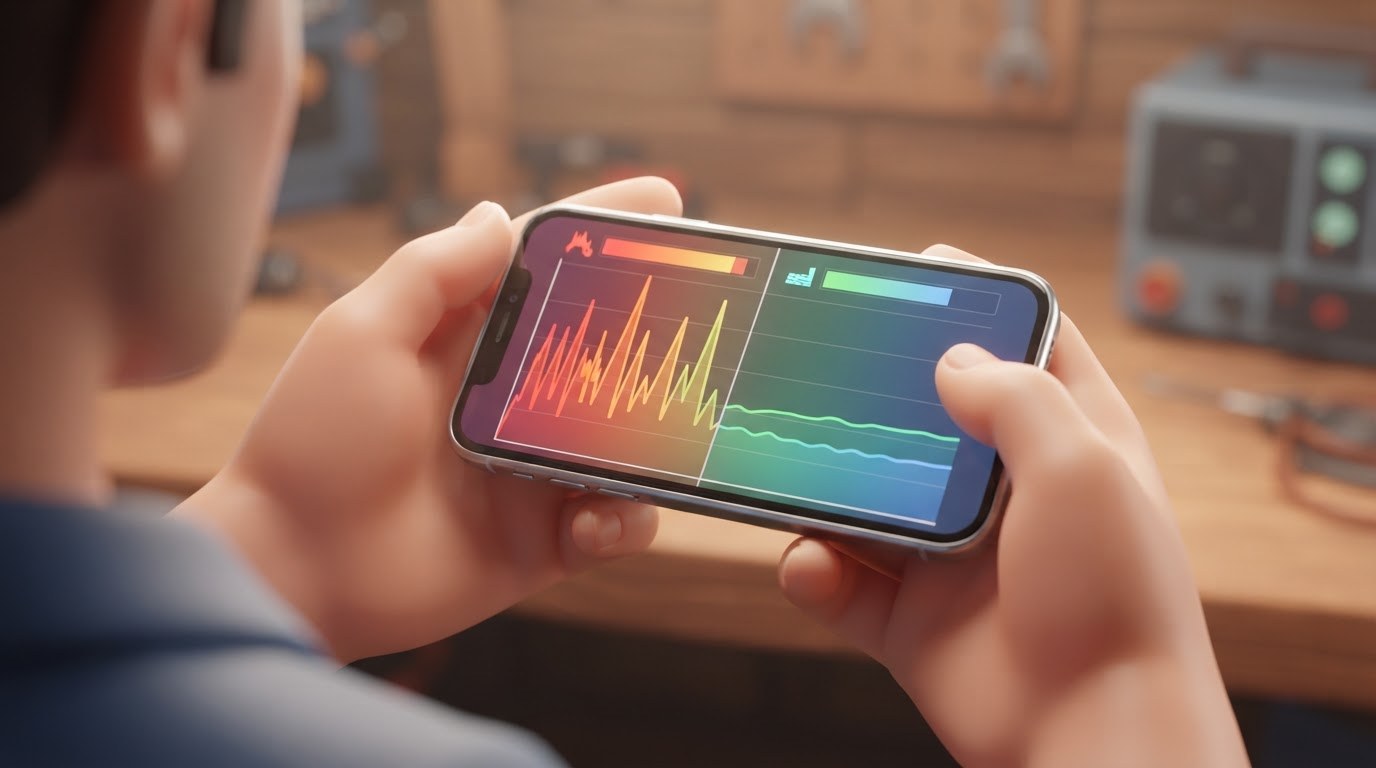
In 2026, automatic rigging via neural networks has ceased to be an experiment but hasn't become magic either. Tools like AutoRig Pro ML or native pipelines in Blender 4.5 and Unreal Engine 5.6 provide an excellent base in seconds, yet "raw" exports still break the game during integration. The main risk is false confidence in the pipeline. If you accept the result without strict filtering, technical debt accumulates exponentially with every new asset batch.
Critical Errors in Automatic Skinning and Hierarchy
- Double Transform. The most frequent problem when generating a Control Rig from video reference (Motion-to-Rig). The network might bind geometry to bones and leave active corrective Blendshapes that are already accounted for by the bone pose. As a result, the mesh jitters or stretches twice as much. Check: Freeze bone deformations in T-pose; if the mesh deforms on its own—look for extra shapes or Skin modifiers after Morpher.
- "Phantom" Parenting. AI often creates intermediate null nodes to compensate for axes, forgetting to set Inherit Scale/Rotation flags to False. During running animations, legs start scaling along with the torso. The checklist requires passing all joints through a scale check utility (World-Space Unit Check) before skinning.
- Weight Collapsing at Joints. Generative grids love drawing hard boundaries where smoothness is needed. Elbows and shoulders receive zero weights on bending polygons. In Godot 4.4, this leads to mesh tearing when using physics correctors like JiggleBone.
- Normal Inversion under Weight. During aggressive weight transfer from a library (Weight Transfer AI), internal cavities of gloves or armor may invert only at specific hand rotation angles.
Manual Final Polish Methods
The transition from draft to production takes a Technical Artist about 30–40 minutes per character if following a strict protocol. First, clean up the topology of weights. Use tools like Quad Weight Painting: forcefully convert deformation zones into quadrilateral weight distributions (100-0, 75-25, 50-50), cutting off random values like 33.3% or 8% generated by noisy models.
The second stage is center of mass stabilization. Neural Network Motion Capture provides lively but dirty hips (Hips). Apply a Sliding Average Filter exclusively to the root bone's Y-translation, leaving X and Z sharp for gamepad responses. This removes the "drunken walk" effect characteristic of raw data from Apple Vision Pro SDK 2 or Rokoko Video.
Specifics of Real-time Shapes (Blendshapes)
If facial animation was generated by Audio-to-Face models, control the number of active targets. Modern GPUs allow keeping hundreds of shaders, but runtime LOD drivers cut them. Bake micro-expressions (weight below 5%) into texture maps of Normal Offset compression rather than vertex animation. For Meta Quest 4 and PS VR2 Remix, strictly limit it to 32 active morphs per frame.
Acceptance Checklist (Gatekeeper List) Before committing the asset to Perforce/Git, ensure:
- Skeleton scale is strictly 1.0 / 1.0 / 1.0 in world coordinates.
- There is no negative scale on any bone in the hierarchy—it will break normal calculations in Forward+ renders.
- Root Motion is extracted as a curve separately from the Animation Asset to support Network Replication in UE5.
- Skinning Quality Score (built-in metric Unity 6 Muscle Group Solver) is above 90 points without manual edits on more than 15 joints.
AI accelerates production, but it doesn't understand game context: cloak clipping in narrow doors or the need for IK foot-hooking while climbing. The final word always belongs to the TA who knows the cost of these errors in FPS milliseconds.
Studio Economics: Calculating the ROI of Replacing an In-House Rigger with a SaaS Tool Subscription
In 2026, the question of "hiring a specialist or buying software" for character animation tasks has transformed into a choice between capital and operational expenditures. The market for neural network rigging offers mature solutions capable of generating basic skeletons (FK/IK), binding weights (skinning), and base poses in seconds. However, replacing a key employee with a cloud subscription requires a sober calculation of Return on Investment (ROI). Ignoring hidden integration costs often leads to budget overruns.
In-house Staff Cost Model. In 2026, the median salary for a Senior Character Technical Artist/Rigger in Eastern Europe is approximately $3,500–$4,500 before taxes. Taking into account social contributions and overheads, the studio spends roughly $5,500 per month on one specialist. An in-house employee works not only on creating rigs but also on pipeline support: adapting assets when engine versions change (Unity 6.x LTS with Entity Component System v2.0, Unreal Engine 5.5+), writing automation utilities, and fixing FBX/USD export errors. AI currently covers these tasks only partially.
Subscription Model (SaaS AI Rigging). Modern platforms for animation generation and rigging operate on a token consumption model or a fixed rate per workstation. The average check for an advanced service with API access for batch asset processing ranges from $150 to $400 per user per month. At the same time, the cost of generating a single complex mesh depends on its polygon count. For a medium-sized indie project (about 30 unique characters plus clothing variations), the monthly bill can reach $800–$1,200, including overhead for re-iterations due to weight artifacts.
Break-even Point Calculation. A direct comparison shows the advantage of AI: $1,200 versus $5,500. But the ROI formula must include implementation time. Integrating a third-party API into your editor tool takes a mid-level programmer (~$3,000/month) about two weeks—this is a one-time cost of ~$1,500. Next, consider pipeline speed. If an in-house rigger makes one complex model in 2 days, and AI generates a draft in 3 minutes, the time gain is colossal. However, final refinement of joint shapes (joint orientation) and correction of double rotations after automatic skinning still require manual labor from a junior ($1,200/month).
Hidden Risks and Data Taxes. The main trap of 2026 is dependence on the cloud. During peak loads, service latency increases, blocking the art department's work. Furthermore, data exported through AI may contain topology weights that are suboptimal for mobile platforms (Quest 4, Vision Pro 2). Manually optimizing such a rig consumes up to 40% of the saved time. The legal aspect is critical: ensure that the SaaS license grants you full rights to the output mesh without royalties; otherwise, stores like Google Play or App Store might reject the build during an audit of asset origin.
Optimal Hybrid Strategy. The best ROI indicator comes from refusing to hire a second Senior rigger in favor of a combination of Junior TA + SaaS subscription. The neural network provides the base in minutes, the junior cleans the mesh and sets up cloth physics (Chaos Cloth / NVIDIA Flex), while the Senior connects only to create complex facial setups (Blendshapes) and procedural controllers. This scheme reduces the payroll fund by at least 35% while maintaining quality control. Savings reach their maximum during pre-production when dozens of mobility pack variants need to be quickly prototyped to test meta-hypotheses.