


Early Access 2026: What Actually Drives Impressions and Conversion
In Steam 2026, Early Access is not a "trust discount," but a full-fledged stage of the product lifecycle. Discovery Update algorithms evaluate EA using the same metrics as released products: CTR from the feed, page CR (wishlist per viewer), first-session retention, refund rate, and event generation frequency. The only difference lies in the weights: for EA, higher significance is placed on predicted LTV after 1.0 and community signal dynamics.
CTR from the Feed: The main lever today is Events & Discounts with correct Creative Assets. A preview video up to 30 seconds should start with a gameplay hook within the first 2–3 seconds, without launchers or logos. Cover art is tested via Asset Kiosk A/B: at least two icon versions and three capsule creative variants for different audiences. In your tag grid, keep the genre core plus two or three behavioral tags ("cozy", "hardcore", "roguelike"), avoiding spam—excessive tags dilute recommendations.
EA Page CR: Honesty and predictability convert best. Place a Roadmap 2026–2027 block immediately above the fold with quarterly milestones, statuses (Done/In Progress/Cut), and a Target 1.0 date. Provide a matrix of current content: how many campaign hours are playable, which modes are stubbed out, and where AI-assist is used as a placeholder. You must show Performance Profiles: minimum and recommended specs separately for Windows, Linux (SteamOS), and Steam Deck, including upscalers (FSR 3.x/XE SS). Add a Save Policy section: will progress carry over to 1.0? This removes the fear of wasted time.
First-Hour Retention: Algorithms watch D1 retention for EA players almost as closely as for full releases. To achieve this, the demo inside the EA build must be a self-contained vertical slice: a complete loop, readable onboarding without overload, and autosaves every 5–10 minutes. It is critical to avoid softlocks and crashes at session start—a stability drop instantly cuts visibility across all recommendation surfaces.
Wishlists and Velocity: Spikes come from calendarized events. Plan monthly micro-drops: a new biome, tool, or balance patch tied to an Event Page with a 15–20 second trailer. Sync schedules with seasonal Steam sales, but run separate in-game events outside store discounts—this generates Daily Active Users without price pressure. Enable the Notify feature for Followed Updates in spring 2026: each update automatically pushes subscribers, increasing announcement open rates.
Community Signals: Reviews remain a strong factor. Pin Developer Commentary under top reviews weekly, closing petitions from the Hub. Use built-in Surveys in-game to measure difficulty funnels and drop-off reasons—publish aggregates in news posts. This reduces negative review variance and boosts the Popularity Trend score considered by collaborative filters.
EA Pricing: Price should reflect the volume of ready-made gaming experience, not promises. As you expand the content base, raise prices incrementally, announcing the transition 14 days in advance. Sudden jumps break wishlist conversion and trigger waves of refunds, which the algorithm penalizes most severely.
Technical Compliance: SDK Steamworks 2026 requires an explicit isEarlyAccess flag in the manifest and a valid Rich Presence status string. Family Sharing for EA is enabled by default, but you can restrict it via parameters—account for this when testing multiplayer economies.

Roadmap Without Pain: Promises, Ranges, and Anti-Overpromising
In 2026, Steam algorithms are sensitive to retention after updates. Peaks in DAU/CCU are good, but their collapse on the second or third day hits visibility harder than a "quiet" week. The roadmap has ceased to be an advertising poster; it is a contract with the community. Your task is to promise less, deliver more stably, and prevent ER from dropping due to disappointed expectations.
Quarterly format instead of dream sprints. Break down the Early Access cycle into quarters Q+1..Q+4. Within each quarter, use three layers:
- Must-have (core): things without which the build loses meaning or breaks progress. One or two items per quarter.
- Should-have (meta/social foundation): systems that boost weeks 2–4 retention.
- Nice-to-have (polish): cosmetics, local features, optimizations.
Never place Nice-to-have items into Must-have just for a pretty update trailer.
Risk buffers as part of the plan. For each quarter, allocate an explicit buffer of 25–35% time for unforeseen events: store SDK integrations, critical fixes for Linux/Proton platforms, antivirus certifications, EAC/BattlEye adjustments. In the roadmap, create a separate slot for "Buffer & Hotfixes". If it's empty for two months straight, you are either planning geniuses or hiding technical debt. The latter will backfire with review drops during major patches.
Formulation rules to protect trust. Avoid hard release dates for features inside EA. Use ranges ("end of Q+2") and infrastructure readiness statuses:
- "Researched": concept exists, no prototype yet.
- "In Progress": playable vertical slice.
- "Under Community Review": being tested privately.
- "Blocked by external dependency": Epic Online Services / provider server update.
If the blocker is external—state it immediately. Players forgive service delays better than sudden cancellations of your own mechanics.
Protecting Engagement Rate (ER). New Release ranking and recommendation algorithms are sensitive to the share of players who launched the game within 72 hours after an update. Plan content releases for Tuesday-Wednesday morning UTC so the global community has a window before the weekend. Before a major content patch, always deploy a stability hotfix 24 hours prior: this way the main wave of users encounters new content on a stable client. This reduces waves of negative reviews like "they added new stuff but broke the old."
Promise rollback mechanics. Sometimes a feature needs to be removed from the nearest quarter. Do this via an intermediate Dev Pulse post 3–4 weeks before the intended window. Message formula: what we are postponing, why (briefly technical), where we are moving it (next quarter), what the player gets now instead (QoL compensation). Never stay silent or change the map quietly—WebArchive caches screenshots, and trust takes months to restore.
Connection to visibility. An update must change at least one card hook: key icon art, first three screenshots, or a short video. But visuals must match the actual state of build version X.Y.Z. A discrepancy between the trader's frame and the current Main Menu instantly increases the bounce rate from the store page, and Discoverability pessimization kicks in faster than you can push a fix.
Patch Rhythm 2026: Windows, Build Size, and Impact on Quality Index
In the Steam Discovery Update of the "2026" generation, the Quality Score has become more sensitive to session stability, the share of crash-freezes after an update, and team response speed. Ranking algorithms in Upcoming/New and Trending now consider not only sales volume during the launch window but also D1/D7 retention without performance degradation across versions. The rhythm of updates is no longer a matter of studio preference; it is a lever for visibility.
Basic release calendar. For Early Access, a two-week cycle of substantial minor versions with a one-week stabilization buffer is optimal. Every two months—a major content patch announced in advance as the event of the week. This pattern provides the algorithm with stable spikes in Day 1 Retention around the release date and keeps the store page fresh without the effect of being "perpetually WIP." Avoid Fridays for heavy builds: support load peaks will coincide with weekends, increasing the share of negative reviews due to regressions. The best slots for PC audiences in 2026 are Tuesday–Wednesday afternoon European time; this allows you to capture US players that same evening and avoid drowning under the wave of Thursday AAA releases.
Build size and incrementality. Steamworks now encourages delta-updates with proper content segmentation. Keep the game core at 1.5–2 GB, moving the rest into optional Chunks: HD textures, campaigns, localization beyond base languages. Laptop and handheld users massively disable auto-downloading of non-essential data—the smaller the mandatory weight of the update, the higher the percentage of the current user slice and the lower the churn in the first hour after the patch. Enable binary compression for IL2CPP builds via the Sustained Performance Mode profile, test startup times on NVMe and HDD: the penalty for slow launches hits Session Stability metrics harder than losing a couple of FPS.
Hotfixes: Threshold policy. Introduce incident levels. Sev1 (core crashes, progress loss, progression blockers): A/B rollout hotfix within 24 hours with feature flag disabling of the problematic module. Sev2 (soft locks, frequent network disconnects): candidate build in weekend branch, release in the nearest allowed slot with a detailed Changelog Hotfix Only. Sev3 (visual bugs, balance): go into the next minor version. Use staged rollout 10→50→100% with automatic stop based on Crash-Free Sessions growth from version N to N+hotfix. This directly feeds the Quality Score through deployment discipline.
Churn control around major versions. One week before a major freeze architecture, keep feature flags for controversial systems. Launch a closed stress branch for Discord Premium subscribers or long-time WL holders: collect telemetry on CPU/GPU stalls, P95 level loading. On release day, plan a rollback window for 6 hours and have a Community Manager on duty with templates for responses to the top 5 known issues. Publishing Known Issues simultaneously with the change log reduces review toxicity—the algorithm sees the ratio of Helpful upvotes to negativity.
Steam seasonality. Do not schedule large patches right against Sale dates: the sale consumes organic traffic events. Ideally, release an update 10 days before a seasonal sale: it provides a fresh news hook, boosts conversion rates on the Sale page, and strengthens positions in Similar to… Shifting the rhythm is only justified for cross-promo with partners, fixing a compensating patch two weeks later.
The bottom line is simple: a predictable bi-weekly pulse, lightweight mandatory deltas, strict hotfix gradation, and testing discipline before majors increase session stability and discussion quality. It is precisely this set of metrics that currently pulls Early Access pages up in Steam search results.

Community Hubs for Steam: Discord, Discussions, Creator Hub, and Moderation SLA
In 2026, the ecosystem around Early Access rests on three pillars: Discussions as "public memory," a Discord server as an operational layer of feedback, and Creator/Lab Hub for mod authors. Visibility algorithms read not only page conversion but also update frequency, the share of resolved tickets within a time window, and the quality of dialogue with the audience. The goal is to turn channel noise into a structured flow without losing pace.
Role separation between channels. In Steam Discussions, we log bugs by template (build, platform, logs), balance hypotheses, and feature requests; we close duplicates and tag them [Bug], [Feature], [QoL]. On a pinned post, we maintain a Known Issues board with patch timelines. We switch Discord to rapid response mode: #bug-report-bot via in-game widget or /bug command, #gameplay-help, #roadmap-sneak. For balance, we hold voice Design Review sessions bi-weekly with recording and a summarized thread-postmortem.
Moderation and Response SLA. Without measurable thresholds, communities degrade into toxicity. A working SLA grid for EA slices: initial response in Discussions up to 12 hours during the day/up to 24 at night; bug report confirmation within 8 business hours; target closure of critical crashes via investigation or fix in the next build; Discord support reaction within 30 minutes during prime-time duty shifts. Moderators work from a de-escalation checklist: acknowledge the problem, request data, link to the template, move to tracker ID, public status update.
Routing feedback to the backlog. We integrate Zapier/n8n or an internal gateway: new Discussion threads with required tags automatically create Issues in Jira/Youtrack with filled fields BuildID, Platform, Attachments, and a link to the original. Comments from Discord arrive as task comments when mentioning the dev-link role. Every Friday, Reconciliation occurs: mapping Community P0/P1/P2 labels against development priority Impact×Reach/Effort. The sprint outcome is published as a Change Log Digest in two lines: what was solved, what was postponed and why.
Creator Hub and mods as a Retention lever. Early Access benefits from user-generated content. We publish a stable SDK for plugins of the current engine version, a basic set of visual scripting nodes, and an example integration of author analytics. We include a local Sandbox Launcher for testing without a full game rebuild. Store requirements are neutral, but policy transparency matters: a separate EULA addendum for modders, prohibition of monetization outside official partner CurseForge-Paywalls, labeling AI-assists inside assets. Once a month, we release a Compatibility Matrix API versions vs game builds to reduce the wave of broken setups after patches.
Communication quality tools. Automatic FAQ blocks in Discussions pull based on keywords; default replies contain links to launch guides, file verification, and minidump instructions. In Discord, we enable Thread Summaries Premium, auto-archiving inactive branches after 7 days, and an external store spam filter. Report templates are standardized: reproduction steps, expected behavior, actual behavior, frequency, video/GIF ≤ 15 MB, DxDiag/upload.valve diagnostics.
Hub health metrics. Track Median First Response Time, % Bugs Confirmed within 8h, Top 10 Upvoted Items Carryover Ratio, Mod Crash-Free Rate post-patch, Supportable Configurations Coverage. Separately monitor Sentiment Velocity before updates: sharp negativity requires a preventive Dev Letter with a stabilization plan for two hotfixes ahead.
When discussions become a source of tasks and Discord becomes a line for quick anomaly detection, the algorithmic showcase responds with growth in impressions to converting users. Transparency of deadlines, predictability of mod compatibility, and strict SLA transform Early Access from a risk zone into a manageable cycle of trust.
EA Page ASO: Graphics, Videos, System Requirements, and Localization
In 2026, an Early Access page is not a "placeholder," but the primary growth landing page. Steam algorithms rank based on aggregate CTR in the Discovery Queue/search grid, Visit→Wishlist conversion, and retention after installation. For an EA audience, three things are critical: honesty about development status, measurable progress, and predictable performance on their hardware.
Capsule (Hero Image). Test A/B via Points Shop for at least two weeks on a segmented audience. Working patterns for PC indie: contrasting logo + readable descriptor format ("Survival EA" / "Roguelite v0.8") and a micro-icon of the roadmap directly on the capsule. Avoid renders without gameplay; algorithms penalize capsules with high bounce rates. The version for OLED/Dark Theme requires light text borders. Create an alternative capsule for RU/CN with adaptive typography: Cyrillic is wider than Latin, so leave safe areas from the edges.
Video Trailers. The first frame decides the session's fate. In the first 3 seconds, show the core loop, control platform (K+M or controller), and build version up close. Next — the roadmap to 1.0 as a list of releases, followed by a short performance block: a benchmark scene with an FPS counter at the target graphics preset. End with a clear Call-to-Action like "Add to Wishlist to get notified about Major Updates." Main trailer duration should be 60–90 seconds, plus a vertical Cut for profile cards. Enable subtitles by default and upload audio tracks as separate files: EN/RU/CN/JP/KR — this wins you reach in regional feeds.
Tags and Metadata. Prioritize top-5 popular genre beacon tags, then specific mechanics and EA-communication signs: Roadmap Shown, Frequent Updates, Controller Support. Do not overload with rare tags for coverage sake — they dilute the convertible audience profile and lower the relevance score of search results. Use hidden field keywords for usage scenarios: "low-end laptop playable", "no ray tracing required", "offline singleplayer".
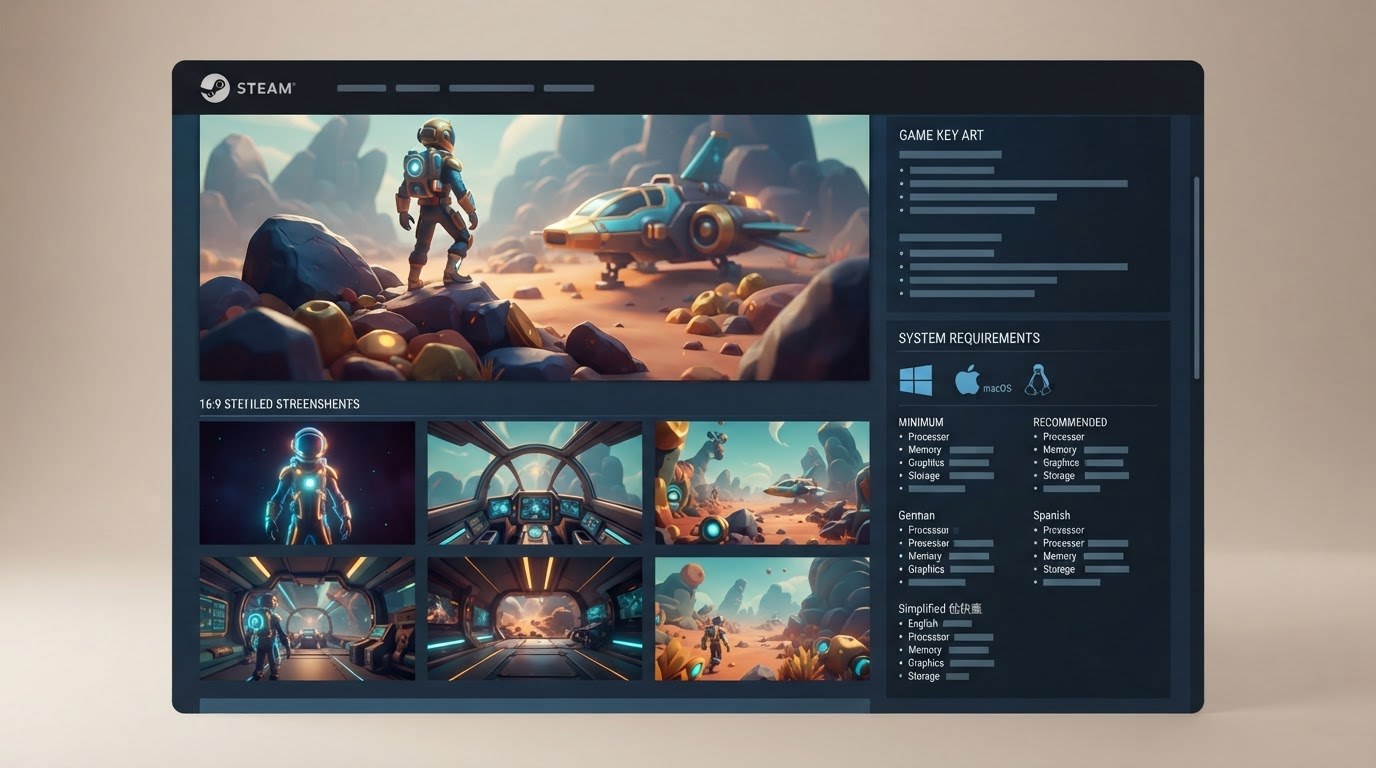
System Requirements. Switch to Minimum/Recommended per Preset format. Pairs Low/1080p@60, Medium/1440p@60, High/4K DLSS/FSR Balanced are mandatory. Explicitly state API DirectX 12/Vulkan, Windows 10/11 build versions, SSD requirement as default, and RAM accounting for Discord browser tabs. Add a Not Supported section: Mac BootCamp, old GPUs below Ada/RDNA 2 architectures. Separately highlight Performance Notes: combat vs world framerate, crowd NPC impact, known regressions in build X.Y.Z with ETA fix. This reduces returns and negative reviews regarding optimization.
Store Localization. Localize Beyond Strings. Make the Russian hub a separate narrative: focus on client stability, update size in GB, support for region-specific authorization providers. The Chinese variant should store simplified infographics of the roadmap and explicit compatibility notes for Family Sharing and CN-partner cloud saves. Japanese — add a note about native IME input support and voice-over localization status quo. Update Change Logs simultaneously across all languages; desynchronization drops segment conversion rates.
Social Proof within ASO. Pin a developer comment once per sprint with KPI updates: number of closed backlog tasks, median FPS on RTX 3060-class hardware, date of next Major Patch. Collect player pins thematically: Bug Reports separately from Feature Requests — moderation accelerates project maturity perception by trust algorithms.
Go-Live from EA: Release Criteria, Review Migration, and Maintaining Momentum
Transitioning from Early Access to Full Release is not just a badge change; it's a storefront relaunch. In 2026, Steam algorithms evaluate the stability of metrics before and after "go-live." The threshold signals are simple and measurable: positive review ratio for the last 30 days above 80%, stable CCU without drops on patches, crashes below 1% of sessions via Sentry/Telemetry, average session time matching the declared cycle, refund-rate stably <5%. Add infrastructure readiness: matchmaking queues handle peaks +200% of current online, anti-cheat is up-to-date, Proton builds are verified.
Formulate release criteria publicly well in advance of the date. Players care about three things: completeness of promised systems (roadmap closed at least 95%), absence of UX blockers, and predictable economy. Internally, fix the Definition of Done for key features: performance on target configs, autosave coverage, interface localization ≥95%, first session tutorial ≤7 minutes with >70% completion rate. A release candidate must spend two weeks on an internal branch without critical fixes; otherwise, the date moves.
Review migration requires caution. Valve preserves EA review history, but their weight gradually declines against fresh FR opinions. To soften the drop:
- 14 days before go-live, freeze controversial balance and price changes.
- Release a technical "stabilization" patch 7 days prior: fix memory leaks, network jitter, controller compatibility issues.
- On launch day, publish the changelog as "Release 1.0," avoiding early access terminology on the update page.
Communication should transition the community from co-authors to companions of the full launch. One month out, announce a six-month support roadmap: seasons, PvP tournaments, editor/modding, console port if resources allow. Assign KPIs to the community manager: first response speed <2 hours, SL1–SL2 bug ticket closure within 48 hours, weekly Known Issues report with ETA. This reduces toxicity and keeps reviews constructive.
The visibility algorithm loves momentum. Prepare the release spike correctly:
- Metadata: update capsule, use "after" screenshots, short 0:30 trailer focusing on completeness; add Endgame, Co-op/PvP tags based on actual game modes.
- Discovery: plan participation in Weeklong Deals temporary selections 10–14 days after 1.0, when D7/D14 Retention stabilizes.
- Pricing: switch to new bundle structures only after a week to avoid polluting card A/B positions.
- Technical events: enable Rich Presence with act progress, providing free impressions in friends' feeds.
Retention matters more than the peak. Focus on the first weeks: this is where organic LTV is decided. Launch an in-game First Week Path track with soft rewards for D1–D7 logins, daily contracts, and guaranteed low-rarity cosmetic drops. Simultaneously monitor the conversion funnel Store → Wishlist → Purchase → Install → Tutorial Complete. If the Tutorial dips by more than 10 percentage points compared to EA—rollback UI hinting surgically, don't wait for a major patch.
Finally, protect content rating compliance. Rebuild the store-page according to current IARC/PEGI/ESRB 2026 rules: properly label AI-assisted assets, deepfake voice if present, user-generated content, and social SDK integrations. Non-compliance leads to recommendation hiding. The bottom line is simple: transparent gate criteria, a quiet stabilization week, managed metadata momentum, and disciplined tickets turn the end of Early Access into a sustainable Full Release without resetting project inertia.