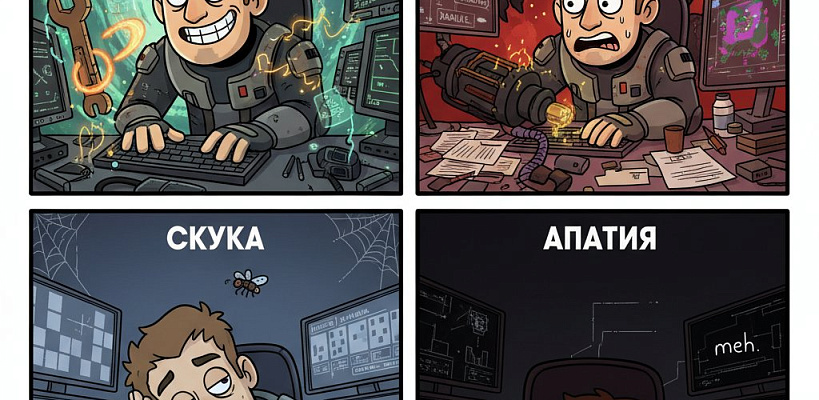

Introduction to the flow state
The flow state, or "flow", is a special psychological experience in which a person is fully immersed in what they are doing. At this moment, they feel a surge of energy, complete involvement, and genuine enjoyment. The Hungarian-American psychologist Mihaly Csikszentmihalyi (1934–2021), who created this theory, called it "the smooth merging of action and consciousness". In this state, time seems to distort, a person forgets about themselves, and control over the situation feels natural and effortless.In his book "Flow: The Psychology of Optimal Experience" (1990), Csikszentmihalyi explains that flow arises in activities with clear goals, immediate feedback, and an ideal balance between challenge (task difficulty) and skills (a person’s abilities). Imagine being so engaged that you forget about food or sleep. This is exactly what makes games "addictive": game designers masterfully balance difficulty so that the player does not get bored (when the task is too easy) or nervous (when it is too hard). In this article, we will break down Csikszentmihalyi’s theory, see how it works in the levels of Super Mario and Dark Souls – classic games in the platformer and "soulslike" genres – and understand why such a balance keeps players’ attention for hours.
To make this more interesting, imagine you are playing your favorite game, and suddenly hours have flown by unnoticed. That is flow! Now let’s break down how designers create this magic.
Csikszentmihalyi’s theory: balance between challenge and skills
Csikszentmihalyi identified three main conditions for flow:- clear goals and visible progress;
- immediate feedback (you see the result of your actions right away);
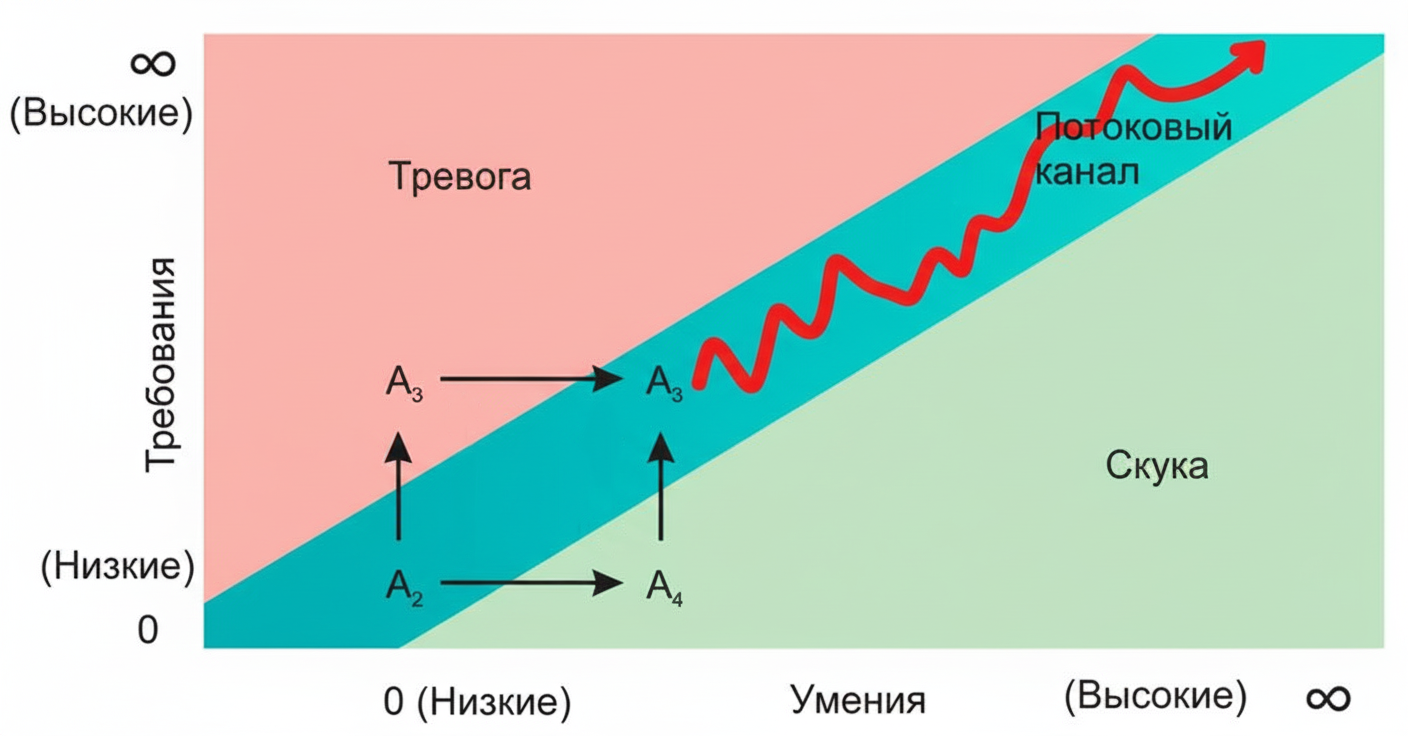
- a balance between challenge and skills, where the task is slightly harder than what you can already do – this pushes you to grow and develop. If the challenge is too weak, boredom sets in; if it is too strong, you get stress and irritation.
- intense concentration,
- merging of actions and thoughts,
- loss of self-consciousness,
- a sense of control,
- distortion of time,
- intrinsic reward (enjoyment of the process itself),
- clear goals,
- immediate feedback,
- balance between challenge and skills.
Here is a simple table to make it clearer:
| State | Skills compared to challenge | Emotion | Example in games |
| Flow | Balance (challenge is roughly equal to skills, but slightly higher) | Full immersion | Beating the first level in Super Mario |
| Boredom | Skills are higher than challenge | Boredom | Repeated resource farming at the end of a game |
| Anxiety | Challenge is higher than skills | Irritation | First Dark Souls boss without prior practice |
| Arousal | Challenge equals skills (both are low) | Nervous excitement | Tutorial level for beginners |
This table shows why game designers strive so hard for the "flow channel". Imagine this in real life: if you are learning to ride a bike, a route that is too easy is boring, while a steep descent is scary. The ideal path makes you exert yourself, but does not crush your spirit.
To make this more engaging, let’s recall a story: Csikszentmihalyi studied artists, musicians, and athletes. One artist said that in flow he forgets about time and food, completely dissolving into creativity. Games work the same way – you "lose yourself" in a virtual world.
Flow in game design: from theory to practice
Jenova Chen, in his work "Flow in Games" (2005), adapted the theory for video games. He believes that games should expand the "flow zone", offering different difficulty levels for both beginners and experts – from casual players to hardcore gamers. The key is dynamic difficulty tuning: not automatic (when the game silently changes parameters based on your actions), but active, where the player chooses the level through game mechanics. For example, in Tetris the speed gradually increases, forcing you to adapt; in flOw (created by Chen) you evolve by choosing "food", and the levels adjust naturally.Shigeru Miyamoto (creator of Super Mario) and Hidetaka Miyazaki (author of Dark Souls) apply this in different ways: in Mario, progression is smooth and linear, like a good book; in Souls, mastery is built through failure, like in real life, where lessons come from mistakes. Let’s break down these approaches in more detail with real examples from games and interesting facts.
For example, did you know that Tetris was created by Soviet programmer Alexey Pajitnov? You have probably already seen the 2023 movie and know this. Its simplicity is ideal for flow: blocks fall faster, your skills grow, and you stay "in the zone" for hours.

Super Mario: smooth flow progression
Super Mario Bros. (1985) is a true masterpiece of balance. The first level (1-1) teaches the basics: running to the right (limited by the controller), jumping over simple enemies, a question-mark block from which a power-up mushroom drops. The challenge grows gradually: first easy platforms, then pits and fireballs. Checkpoints in the middle of the level let you restart not from the very beginning, returning you to a comfort zone to restore confidence.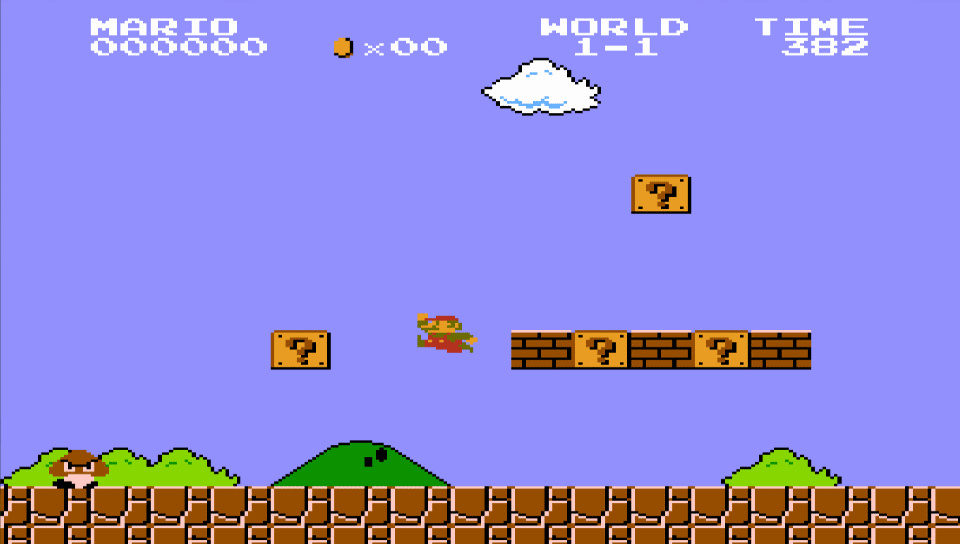
In Super Mario Bros. 3, levels are structured as "lessons": the first world teaches jumping, the second swimming, the third flying. This approach keeps 80–90% of players in flow, reducing churn. A fun fact: Miyamoto was inspired by childhood memories of nature – jumping on mushrooms like on trees. This makes the game not just entertainment but an adventure where every level is a new chapter of a fairy tale.
Imagine a beginner who falls into a pit. Instead of anger, they try again, because the level is short and failure is not scary. For veterans there are secrets – hidden levels that add extra difficulty.
Dark Souls: flow through death and mastery
Dark Souls (2011) is extreme flow for difficulty fans. Miyazaki creates a "stubborn flow": you rush at a boss, die, study its attacks, return, and win – and then comes the euphoria of triumph. Bonfires are respawn points, and souls are experience and currency that are lost on death, motivating you to return and retrieve them.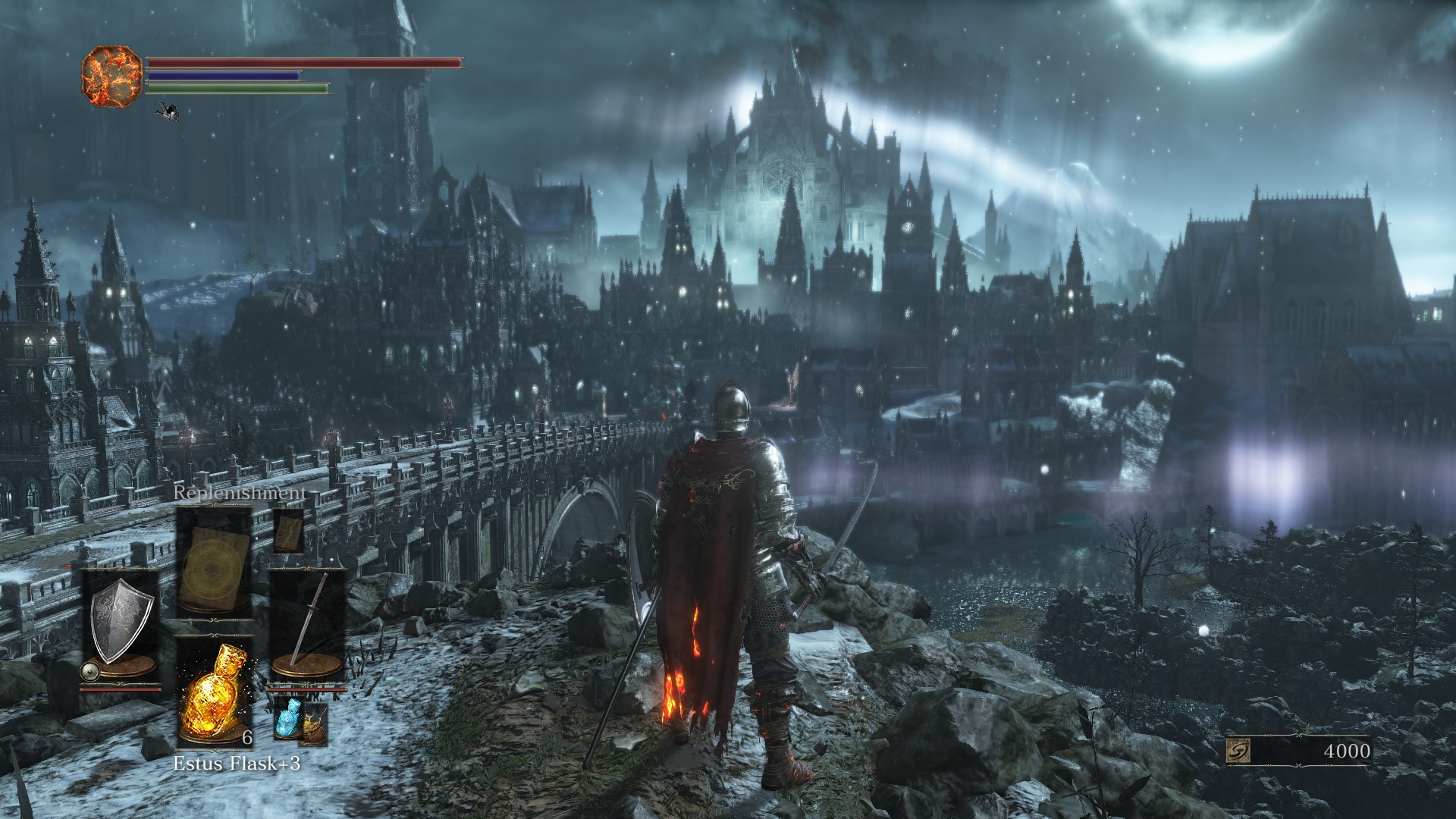
Feedback is perfect: visual effects and sounds telegraph attacks, and the death screen shows the cause. The "death–lesson–retry" loop pushes your skills upward. As in Chen’s model, this is active tuning: you choose your combat style – sword, magic, or shield.
An interesting fact: Miyazaki was inspired by Japanese RPGs and dark fantasy like "Berserk". Players share stories such as: "I fought this boss 50 times, but when I finally won, it was the peak of happiness!" This turns frustration into motivation, making flow "stubborn" but highly rewarding.
Comparing approaches: Mario vs. Souls
Let’s compare them in a table for clarity:| Aspect | Super Mario | Dark Souls |
| Progression | Linear, smooth, textbook-like | Nonlinear, player-dependent, like real life |
| Checkpoints | Mid-level checkpoints with bonuses | Bonfires with the risk of losing souls |
| Feedback | Immediate – death or success | Immediate – death or success |
| Flow for whom | For everyone – low entry barrier | For enthusiasts – high skill ceiling |
| Retention | Short restarts to avoid anger | Long training with triumph at the end |
In Mario, levels are bright with music that motivates you; in Souls, the world is dark and every victory feels like a personal achievement. This shows how flow adapts to genre.
Attention retention: why flow works so well
Flow maximally captures attention: in this state, players ignore distractions and time flies unnoticed. Research confirms that flow is linked to engagement – players return for "just one more level". In Mario, extra-life mushrooms motivate exploring levels, and in Souls, the "New Game +" mode boosts interest for veterans by making everything harder.Both approaches use intrinsic rewards: not just prizes, but a sense of mastery. Modern games like Elden Ring (by Miyazaki) or Celeste combine adaptive difficulty with checkpoints. The result is hours of play without fatigue for the player.